
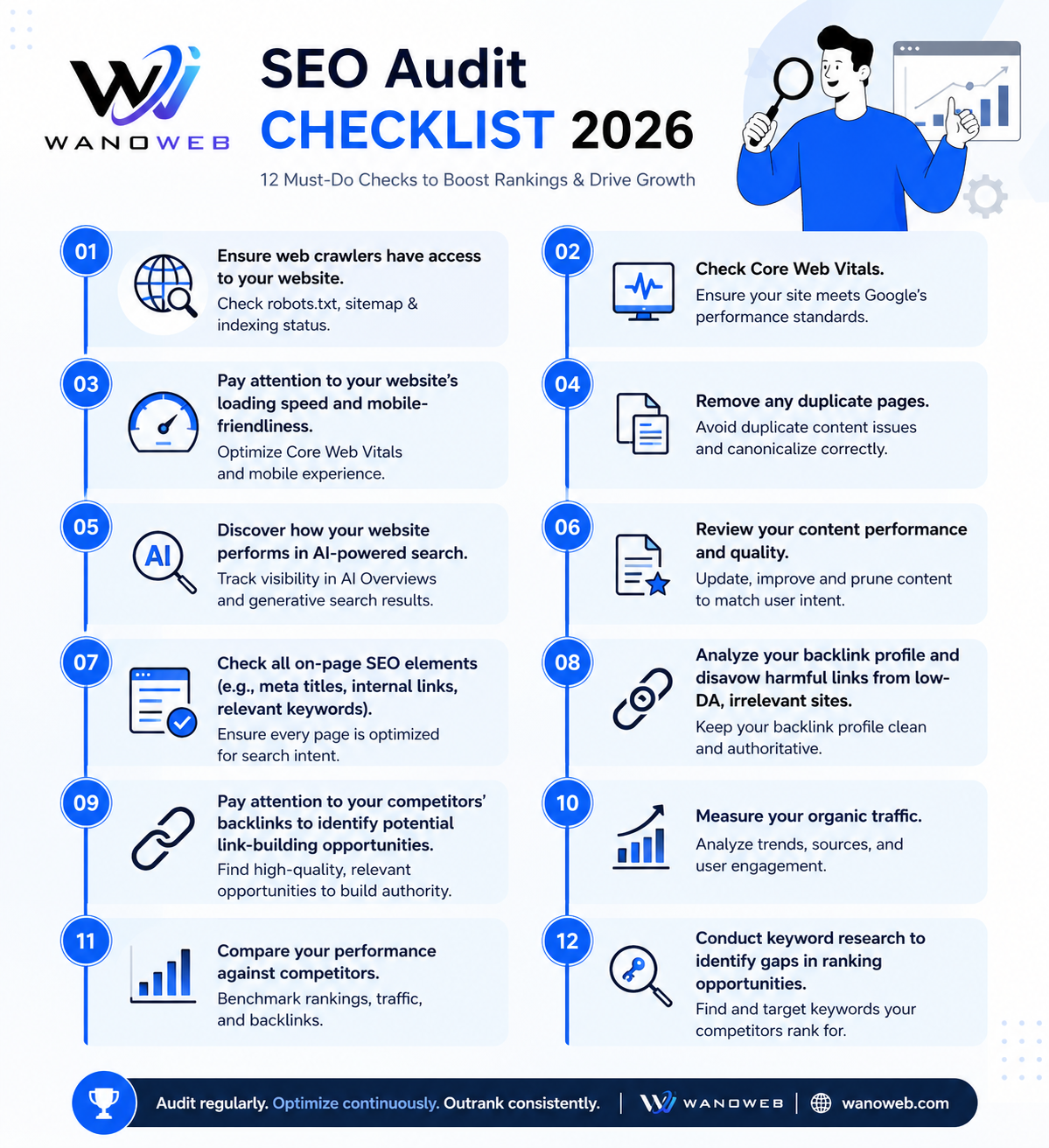

The 2026 SEO Audit Checklist: 10 Things Quietly Killing Your Google Rankings
Most businesses assume that if their site isn’t ranking well, the fix is “more content” or “more keywords.” Usually, that’s not the actual problem.
More often, it’s a handful of quiet technical and structural issues — the kind that never show up unless someone actually goes looking for them. Search engines have gotten far more sophisticated about detecting these issues, and in 2026, they’re also factoring in how well your site performs for AI-driven search tools, not just traditional Google results.
Here’s a practical checklist covering the issues most likely to be holding your rankings back right now.
1. Core Web Vitals
Google uses three specific performance metrics as confirmed ranking factors: how quickly your main content loads, how responsive your page feels when someone interacts with it, and how much your layout shifts around while loading. If any of these fall outside healthy ranges, it’s actively working against you in search results — regardless of how good your content is.
2. Mobile Usability
The majority of web traffic today comes from mobile devices. If buttons are too small to tap accurately, text requires zooming, or layouts break on smaller screens, you’re losing both rankings and visitors in one move.
3. Missing or Duplicate Title Tags and Meta Descriptions
These are still your first impression in search results — and a shockingly large share of business websites have pages missing them entirely, or duplicated across multiple pages, which confuses search engines about which page to actually rank.
4. Missing H1 Tags or Broken Heading Structure
Every page should have exactly one clear H1 that tells both users and search engines what the page is about. It’s one of the most common — and easiest to fix — issues found in audits.
5. Broken Internal Linking
Search engines use your internal links to understand how your site is structured and which pages matter most. Orphaned pages with no internal links pointing to them, or broken links leading nowhere, quietly undermine your entire site’s crawlability.
6. Thin or Duplicate Content
Pages with very little unique content, or content copied across multiple pages, are increasingly penalized as search engines get better at detecting unhelpful or repetitive pages. Every page should serve a distinct purpose and answer a distinct question.
7. Missing Structured Data (Schema Markup)
Structured data helps search engines understand exactly what’s on your page — a product, a review, an FAQ, a business address — and increasingly helps determine whether your content gets pulled into AI-generated search summaries at all.
8. No HTTPS or Security Issues
An unsecured site doesn’t just look untrustworthy to visitors — it’s a direct, confirmed ranking disadvantage. This should be one of the first things any audit checks.
9. Weak or Toxic Backlink Profile
Backlinks remain one of the strongest trust signals in search rankings, but not all backlinks help. Links from low-quality, unrelated, or spammy sites can actively work against you and may need to be disavowed.
10. No AI-Search Readiness
This one is new, and most older SEO checklists don’t cover it yet. AI-driven search tools — Google’s AI Overviews, ChatGPT search, Perplexity, and similar — crawl and interpret your site differently than traditional search engines. Making sure your robots.txt doesn’t block them, and that your content clearly demonstrates expertise and trustworthiness, increasingly determines whether your business gets mentioned in AI-generated answers at all.
Why This List Matters More in 2026 Than Before
Ranking well used to mean satisfying one algorithm. Now it means satisfying traditional search crawlers and AI-search systems at the same time — and they don’t always weigh things identically. A checklist that only covers keywords and backlinks is missing half the picture.
How to Actually Use This Checklist
Don’t try to fix all ten at once. The most effective approach:
- Run a full audit first, so you know exactly which of these issues actually apply to your site
- Prioritize by impact — Core Web Vitals and mobile usability issues usually affect every page on your site, so they’re worth fixing first
- Fix, then re-measure — track whether rankings and traffic actually move before moving to the next item
- Repeat regularly — a real audit isn’t a one-time event; sites drift out of health as content, plugins, and links accumulate over time
The Bottom Line
If your rankings have plateaued or slipped and you’re not sure why, the answer is rarely “write more blog posts.” It’s usually one or two of the items on this list, quietly working against everything else you’re doing right.
Not sure which of these apply to your site? Wanoweb runs full SEO audits covering all ten of these areas — technical health, on-page structure, and AI-search readiness — with a prioritized list of exactly what to fix first.


